Honduras finally frees emergency contraception pills

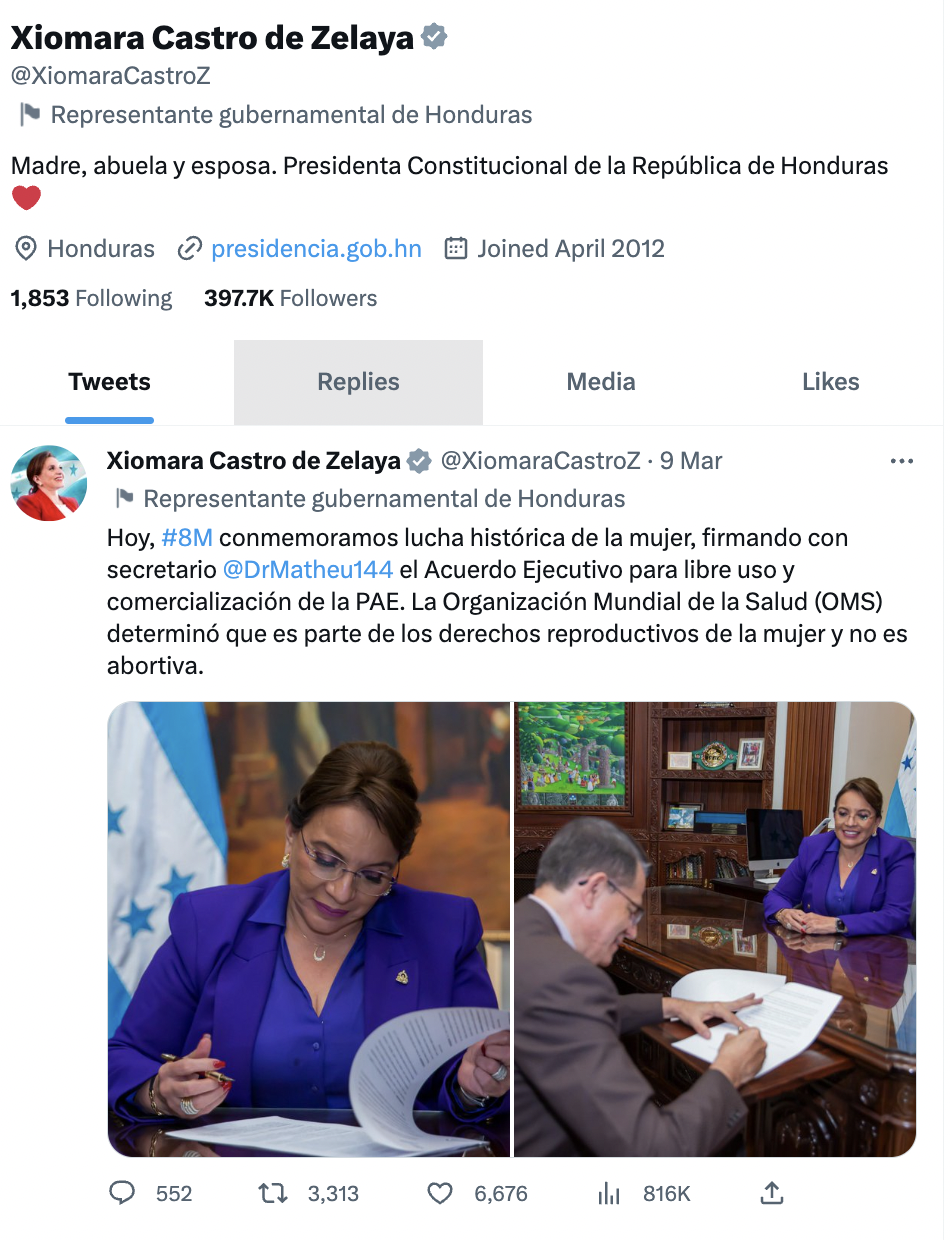
March 2023. Honduras’ President Xiomara Castro announced on March 8 that emergency contraception pills will be allowed to be marketed and used in the country. According to Reuters, the President “signed an executive order ending a ban of more than 10 years on the use and sale of the “morning after pill,” fulfilling a campaign promise long-awaited by feminist groups.” The new policy (Acuerdo Ejecutivo 75-2023) has already been published on the Gaceta (Hondura’s official journal) Num. 36.174, which can be downloaded here.

Since the Executive Agreement 36-2009 (June 29) was enacted, the sale, purchase, use, as well as paid or free distribution and marketing of emergency contraceptive drugs in pharmacies, drugstores or any other means of acquisition, was banned. This prohibition was based on the assumption that ECPs could interfer with implantation or cause and abortion.

Since Costa Rica allowed the registration of LNG emergency contraception pills in 2019, Honduras was the only country in Latin America and the Caribbean that still banned EC. Putting an end to the 2009 Executive Agree was a necessary step to implement the December 2022 protocol of comprehensive care to survivors of sexual violence (Protocolo de Atención Integral a Víctimas / Sobrevivientes de Violencia Sexual), in which EC is part of the first line treatment for survivors.

Similar Posts

  • Global: New IPPF statement on Emergency Contraception

    June 2025. The International Planned Parenthood Federation (IPPF) has released a new statement from its International Medical Advisory Panel (IMAP) on recent advances in emergency contraception (EC). The statement reviews emerging data on several EC-related topics and offers key recommendations to improve access. These include: The full statement is available here in English, Spanish, French,…

  • The cost of EC pills in Central and Eastern Europe.

    September 2024. ASTRA Network (www.astra.org.pl) and the European Consortium for Emergency Contraception presented their latest research findings at the 15th FIAPAC Conference 2024, which was held in Brussels on September 20-21.   This collaborative research looked into the cost of emergency contraception pills (ECPs) in select European countries. Our findings show significant disparities across the region,…

  • Argentina: New data on EC use and access

    November 2024. The Study Lucía: Uses and preferences of contraceptive methods in women aged 15 to 49 years in Argentina, was recently published. This quantitative and qualitative research has consulted 2,000 women and people identifyin as LGTB from all over the nation. The study findings, published in September 2024, include valuable information about access to…

  • In Italy, gynaecologist requests affordable and more accessible EC pills

    The Italian Medical Contraception Society (SMIC)  is requesting to the Ministry of Health and the national Medicines Agency that  EC pills are mandatorily stocked in all pharmacies, in order to make them more accessible and reduce time to start of treatment; and that EC is covered by the national health system, and thus provided free of charged in, at…

  • Use of emergency contraception after sexual assault

    May 2022. The International Association of Forensic Nurses (IAFN) recommends that EC be immediately offered and available to all female (or trans-male) victims of sexual assault or abuse of reproductive age or stage who choose to use EC as a means of protection from unintended pregnancy. Read the whole position paper “The Use of emergency…